
Mining companies collect vast amounts of geological data, yet turning that information into better planning, processing and operational decisions remains one of the industry's biggest challenges.
As the inaugural Jim Askew Evolution Mining Fellow at The University of Queensland's Sustainable Minerals Institute (SMI), Dr Pia Lois-Morales is exploring how geological information generated throughout the life of a mine can be more effectively integrated into decision-making across the mining value chain.
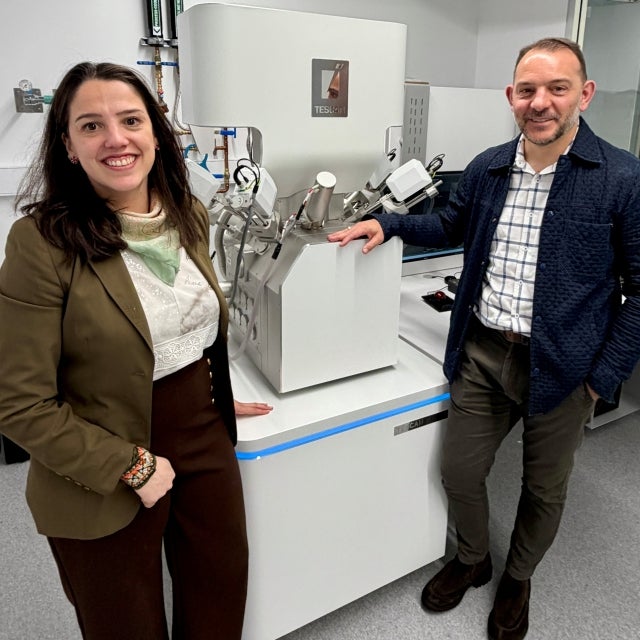
Recently, Evolution Mining's General Manager Long-Term Planning, Stean Barrie, toured the Natural Resources Innovation and Characterisation Hub (NRICH), where he got a firsthand look at the University's new TESCAN Integrated Mineral Analyser (TIMA), a key research capability that will support Dr Lois-Morales' work.
A geologist specialising in geometallurgy, Dr Lois-Morales brings experience across mining operations, consulting and academia in Latin America and Australia, positioning her to tackle challenges that span the entire mining value chain.
"The geological characteristics of an orebody are collected and generated across different stages of the mining value chain and throughout the life of mine," Dr Lois-Morales said.
"That makes geology one of the industry's richest sources of information. The challenge is ensuring that information can be effectively integrated into the decision-making process and used by stakeholders across the mining value chain."
Supported by Evolution Mining, the Fellowship provides an opportunity to investigate these challenges in greater depth while maintaining strong engagement with industry.
"It gives you time to think more broadly and deeply about these challenges," she said.
"I am tackling questions like how do geological characteristics influence outcomes beyond the processing plant? How do they connect to sustainability objectives? How do we integrate information across the mining value chain in a way that becomes genuinely useful?"
New instrument, new opportunities
A key part of that work will be supported by the TIMA, an advanced mineral characterisation platform that provides detailed information on mineral composition, grain size and mineral liberation.
While similar systems are widely used across the mining industry, access to the technology within a university research environment creates opportunities to refine data collection, measurement workflows and data analysis methods, generating insights that can be translated back into industry practice.
"In industry, these systems are often focused on delivering information needed for operational decisions, and there is limited time to explore the full capability of the equipment and the data being generated," she said.
"Having a TIMA at UQ gives us the opportunity to investigate how we can collect better data, improve measurement workflows, refine data treatment procedures and ultimately provide feedback to industry."
"It also allows us to explore how different datasets can be integrated to generate insights that may not be possible within the time constraints of day-to-day operations."
According to Evolution Mining's General Manager Long-Term Planning, Stean Barrie, supporting research that addresses longer-term industry challenges was a key driver behind the Fellowship.
"What stood out about Pia is that she has worked across industry, consulting and academia and understands the challenges from all angles," Mr Barrie said.
"The Fellowship was created to bring that breadth of experience into a research environment, where there is time to explore bigger questions and develop solutions that can deliver lasting benefits for the industry.
“At Evolution, our operations are long-life assets with rich and diverse orebodies. It will be exciting to see how this Fellowship can make a positive and lasting contribution to our business.”
Tackling geometallurgical challenges
Professor Mark Noppé, Director of the WH Bryan Mining Geology Research Centre (BRC), said addressing geometallurgical challenges requires expertise from across the mining value chain.
"At SMI, we're fostering research that looks beyond individual parts of the mining value chain and considers how decisions made upstream influence outcomes downstream," Professor Noppé said.
"By bringing together expertise across geology, mining, processing and sustainability, we're helping address some of the industry's most complex challenges."
With the Fellowship now underway and the TIMA capability coming online, the research will focus on developing practical frameworks and tools that help mining companies better understand ore variability, improve operational decision-making and unlock greater value and better sustainability outcomes from the data they already collect.


