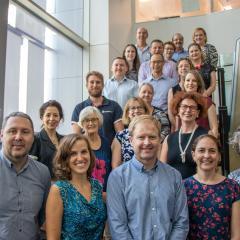
Goldschmidt 2026 in Montréal brought together the global geochemistry community at a pivotal moment for mine waste science. As co-chair and convener of session 05k – Challenges and Innovations in Mine Waste Remediation and Reprocessing for Sustainable Resource Recovery (Theme 05: Energy, Resources, and the Environment), I had the privilege of helping shape a day of discussions that spanned molecular-scale mechanisms to field-scale solutions.
The University of Queensland’s Minerals Industry Safety and Health Centre (MISHC) continues to see strong engagement in its Bowtie Facilitation Course, with the next delivery scheduled for August at the St Lucia campus.
Recently, BRC Postdoctoral Research Fellow Dr Steve Jason Chingwaru had the opportunity to present his research and chair at the MEI’s Physical Separation Conference 2026 in the beautiful but stormy Cape Town, South Africa.
Mining may stop, but the legacy (waste) it leaves behind often keeps moving. In this MIWATCH blog, Dr Elin Jennings explains how in in rivers affected by acid mine drainage (AMD), metal(loid)s like arsenic, copper and zinc don’t just disappear once mining ends.
Samantha Krause, a Bachelor/Master of Engineering student is undertaking her industry placement at the Sustainable Minerals Institute. Her project integrates empirical liner wear prediction models with Deep Reinforcement Learning (DRL) in SAG mill, Ball mill, and Crusher circuits, commonly known as the SABC circuit in the industry.