
Classical Arabic music plays as a four-wheel drive full of participants in Saudi Arabia’s Ministry of Industry and Mineral Resources Youth Graduate Program (YGP) cruises past camels and dry, rocky outcrops. While the scene might suggest the Middle East, the group are outside Mount Isa, north-west Queensland’s major mining town.
The Kingdom of Saudi Arabia is known for its oil and gas, but as part of its Vision 2030 national reform agenda, the government is also keen to mine what it believes to be $2.5 trillion in mineral resources, including gold, zinc, copper and lithium, and possible rare earth deposits.
To equip the next generation of Saudis with globally-competitive mining skills, Saudi Arabia’s Ministry of Industry and Mineral Resources (MIM) built the YGP program and approached The University of Queensland’s Sustainable Minerals Institute to run a 6-week full immersion course including hands-on experience and face-to-face time with globally-recognised experts.
As a multi-disciplinary mining research institute, SMI has experts in a wide range of fields, including field geology, mineral processing, social responsibility and post-mining rehabilitation, who are uniquely placed to teach the young Saudi graduates about every part of the mining process.
After a successful first run in 2025, the latest cohort participated in a program which included an extended field trip to Cloncurry and Mount Isa in April 2026, led by Professor Nick Cook, Acting Director of W.H. Bryan Mining and Geology Research Centre (BRC) and BRC research assistant Dr Sally Allan.
One of the nine participants, Casi Fada Alsubaei, a mining analyst with the Ministry of Industry and Mineral Resources of Saudi Arabia explained how this capacity-building program can help Saudi Arabia to mitigate the environmental and social costs of mining.
“Given that the Kingdom is relatively new to mining, but developing fast, it has the opportunity to be proactive and to come up with pre-emptive solutions to problems before they occur. Obviously, no one can see the future, but looking back on history has always been beneficial, and that's what Mount Isa offers,” he said.
“It's a privilege to have an institute like SMI just give you their attention, let alone talk to these experts in so many fields.”
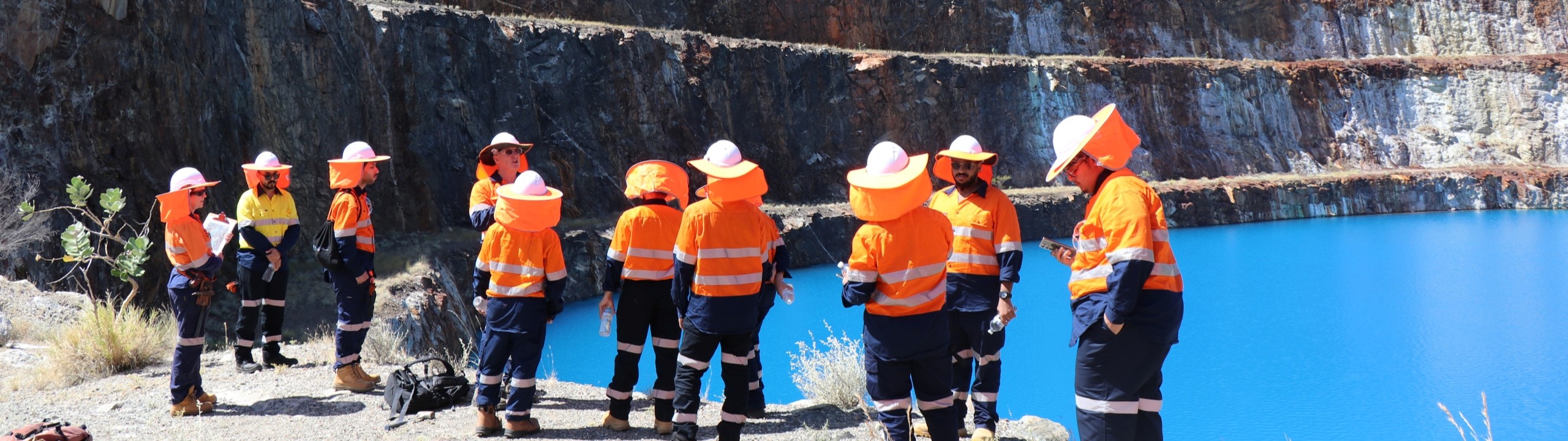
Mary Kathleen: a snapshot of post-mining land use
One of the mines the group visited in north-west Queensland was Mary Kathleen, an abandoned uranium mine. It was once home to a mine, mineral processing plant and a picturesque town of over 1000 people before it shut in 1982 and the buildings were removed.
Under the shade of a massive gum tree where the town square once stood, the Saudi delegation heard about how the deposit was found (via a geologist’s Geiger counter), what the mine was like while it operated and how efforts to return the site to its pre-mining environment were undertaken.
Abdulrahman Musfir Alsubaei, a chemical engineering graduate now working at the Ministry in the Mineral Resources explained that exploring the town and mine was an emotionally-touching experience.
“If I was in the shoes of a kid that born in this town and came back after 20 or 30 years and found it like this, nothing there, I think I would be drowning in tears,” he said.
Later that day, after a run-in with a snake, the group examined the rocks around Mary Kathleen’s mining pit, which now has a lake filling the bottom, whose stunning blue colour is caused by chemical reactions between the metals and salts released from the rocks.
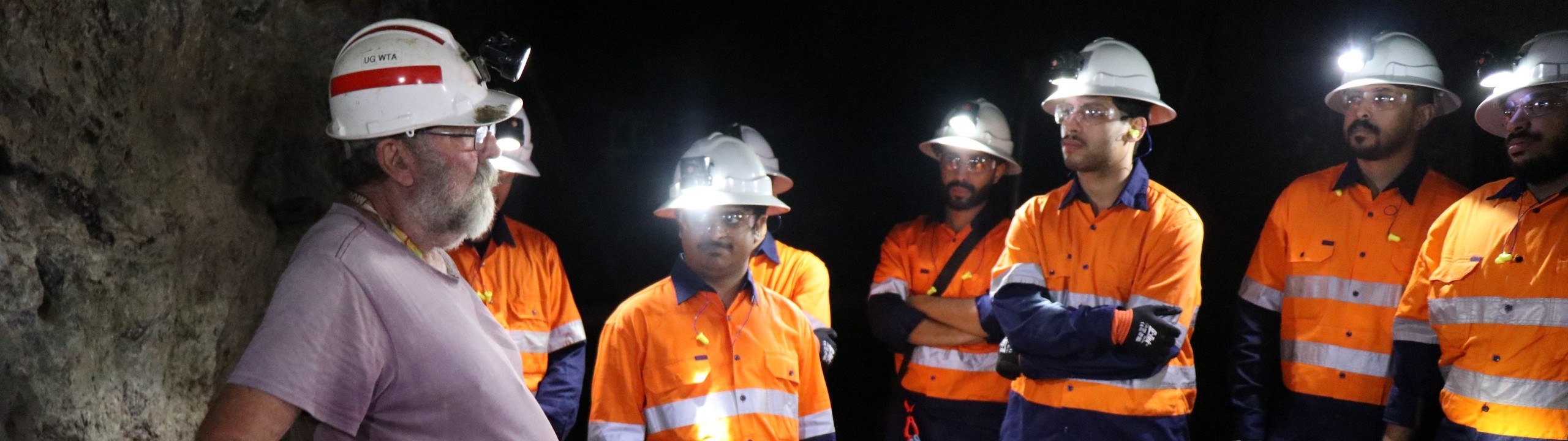
Hard Times Underground Mine Tour
Another highlight of the trip was the Hard Times Mine, a volunteer-run underground mine, complete with real tunnels, real mining equipment and even an authentic “crib room,” where the participants had a coffee and a pastie underground like those who once worked the mines.
Leading the tour was Steve Carson, who worked for decades underground, he urged the delegation never to take shortcuts, especially when it comes to mine safety.
“Steve is going to stick in my head for the next 20 years,” Abdulrahman Musfir Alsubaei said.
Casi Fada Alsubaei was also moved.
“He (Steve) spoke about not even having finished high school, let alone getting a degree and yet his real-world experience trumps all of ours.
“Seeing his life, and his dedication to his craft was extremely impressive, and it was really motivating, especially the part where he said, ‘If I could go back 53 years ago, I'd still do it all over again’. It just speaks to his dedication and passion, and that was infectious for me.”

Meeting with the Mayor of Mount Isa
The group also met with Mayor Peta MacRae and Mount Isa City Council CEO Tim Rose at the council chambers to see how the political administration of a mining town works.
The local officials outlined the strategy behind the Australian Critical Minerals Industrial Precinct (TACMIP), an innovation district planned out near the city’s airport.
Casi Fada Alsubaei explained that the importance economic diversification was hammered home and he was impressed with the “quality of people in charge.”
“I went into the meeting with several questions and I didn't even get to ask them: most of what I had in mind, they already had thought about, analysed, studied, and either put into practice if it was feasible, or dismissed due to reasons that I didn't really think of. What they want to do for a town, we want to do for our entire country,” Casi Fada Alsubaei said.
Back in Brisbane for the rest of the trip, the adventure was not yet over: the participants continued their educational journey visiting labs and other facilities of the SMI in Brisbane, alongside learning activities with SMI’s top researchers.


